

 September 24, 2026
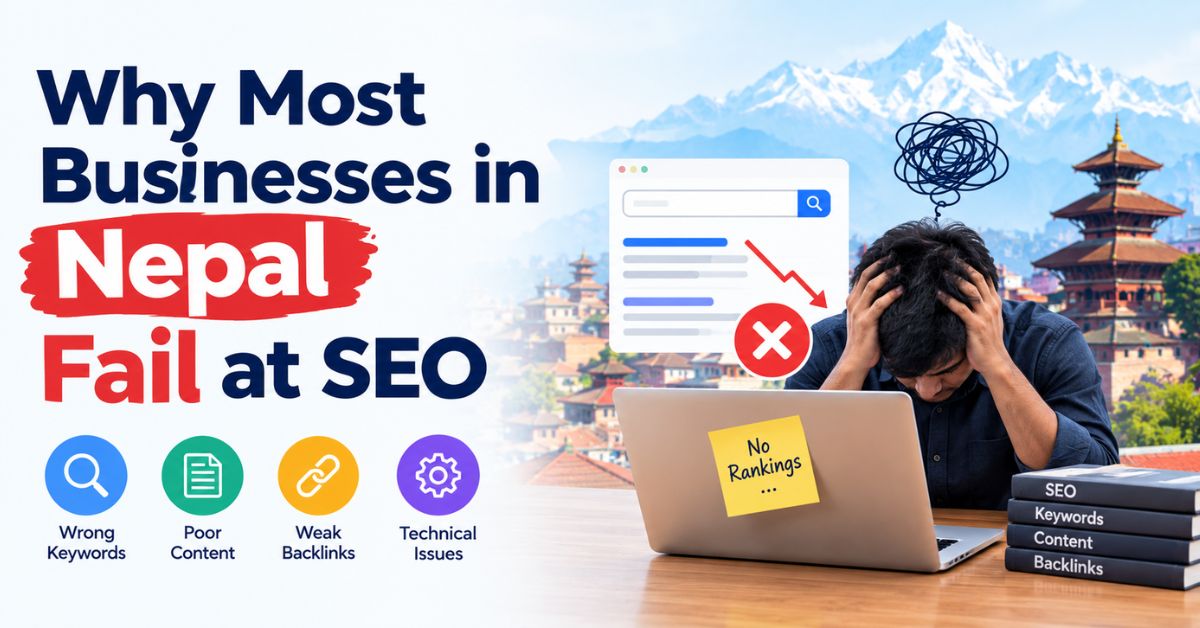
Why Most Businesses in Nepal Fail at SEO
Search engines have become an important part of how people discover businesses, products, and services. Whether someone is searching for a restaurant in Kathmandu, a digital marketing company in Nepal, a hotel in Pokhara, or an education consultancy, Google is often one of the first places they turn to.
For businesses, this creates a major opportunity. A strong search engine optimization (SEO) strategy can help a company attract relevant visitors, generate leads, build brand visibility, and reach potential customers without relying entirely on paid advertising.
Yet many businesses in Nepal struggle to achieve consistent SEO results. In most cases, the problem isn’t that SEO doesn’t work. Instead, businesses often make common strategic, technical, and content-related mistakes that prevent their websites from reaching their potential.
Let’s explore why businesses in Nepal fail at SEO and what they can do differently.
Understanding SEO in the Nepalese Market
SEO is the process of improving a website and its online presence so that it can appear more prominently in relevant search engine results. However, effective SEO isn’t exactly the same for every market.
Businesses in Nepal need to consider local search behavior, competition, language, location, customer expectations, and the types of queries their target audience uses.
For example, a Kathmandu-based restaurant may benefit more from targeting specific local searches such as “restaurants in Thamel” than trying to compete immediately for broad terms such as “best restaurants.”
Similarly, a local service provider may need to optimize its website and Google Business Profile for location-based searches.
Understanding the Nepalese market allows businesses to develop an SEO strategy based on how their actual customers search rather than simply copying strategies from international competitors.
Why SEO Matters for Businesses in Nepal
Consumers increasingly research businesses online before making purchasing decisions. Search visibility can therefore influence whether a potential customer discovers your company or finds a competitor instead.
SEO can help businesses attract organic traffic from people who are already searching for relevant products or services. Unlike some forms of advertising, a well-optimized page can continue attracting visitors over time.
For Nepalese businesses, SEO can be particularly useful for building local visibility, reaching customers beyond their immediate network, and establishing credibility online.
However, achieving these benefits requires a consistent and well-planned approach.
Common SEO Mistakes Nepali Businesses Make
Many Nepali businesses invest in SEO but still struggle to achieve consistent results due to common mistakes and outdated strategies. Understanding these errors can help businesses improve their online visibility and attract more potential customers.
1. Lack of a Clear SEO Strategy
One of the biggest reasons businesses struggle with SEO is that they start without a clear strategy.
Some businesses publish blog posts randomly, add a few keywords to their website, or create social media profiles and expect search rankings to improve automatically.
Effective SEO starts with clear objectives.
Businesses should understand what they want to achieve, who they want to reach, which products or services they want to promote, and which search queries are relevant to their customers.
Without these fundamentals, SEO activities can become disconnected and difficult to measure.
2. Targeting the Wrong Keywords
Keywords connect what people search for with the content businesses provide.
A common mistake is targeting keywords solely because they have high search volume. Highly competitive keywords can be extremely difficult for a new or relatively small website to rank for.
Businesses in Nepal can often find better opportunities by targeting relevant long-tail and location-specific keywords.
For example, instead of focusing exclusively on a broad term such as “digital marketing,” a Kathmandu company could explore more specific searches related to its services and location.
Keyword research should consider search intent, competition, relevance, and the likelihood that a searcher could become a customer.
3. Poor-Quality or Inconsistent Content
Content remains an important part of SEO, but publishing content simply to have more pages on a website isn’t enough.
Some businesses create short articles with little useful information, rewrite content from other websites, or publish several posts and then stop updating their blog.
Search users want useful answers to their questions.
Businesses should create original content that demonstrates their knowledge and addresses genuine customer problems. This could include guides, service pages, FAQs, case studies, comparisons, tutorials, and location-specific resources.
Consistency is also important. SEO content should be treated as an ongoing investment rather than a one-time activity.
4. Ignoring Local SEO
Local SEO is especially important for businesses serving customers in specific locations.
A restaurant, hotel, clinic, consultancy, real estate company, or local service provider may lose potential customers if it doesn’t properly optimize its local online presence.
Businesses should maintain accurate business information across relevant platforms and optimize their Google Business Profile. Reviews, business categories, opening hours, contact information, photos, and location details can all contribute to a stronger local presence.
Creating useful location-specific website content can also help businesses appear for relevant searches in Kathmandu, Lalitpur, Bhaktapur, Pokhara, and other areas.
5. Neglecting Technical SEO
A website can have excellent content but still struggle in search results if technical problems prevent search engines from properly accessing or understanding it.
Common technical SEO issues include:
- Slow page loading
- Broken links
- Poor website structure
- Duplicate content
- Indexing problems
- Missing or poorly optimized metadata
- Mobile usability issues
Regular technical SEO audits can help identify these problems.
Businesses don’t necessarily need to understand every technical detail themselves, but they should make sure someone is monitoring the technical health of their website.
6. Not Optimizing for Mobile Users
Many people access websites primarily through smartphones. A website that works well on a desktop but is difficult to use on a phone can create a poor customer experience.
Mobile optimization includes responsive design, readable text, easy navigation, properly sized buttons, and fast-loading pages.
Businesses should regularly test their websites on different mobile devices and pay attention to user experience.
A visitor who struggles to navigate a website may leave before contacting the business.
7. Expecting Instant SEO Results
Another common mistake is expecting SEO to produce immediate results.
SEO usually requires research, content development, technical improvements, authority building, testing, and ongoing optimization. The timeline can vary significantly depending on the website, competition, industry, and existing authority.
Businesses that expect dramatic ranking improvements within a few weeks may abandon their SEO efforts too early.
Instead, companies should establish realistic goals and monitor progress over time.
8. Focusing Only on Google Rankings
Rankings are useful, but they shouldn’t be the only measurement of SEO success.
A website can rank for keywords and still generate very few customers. Similarly, ranking slightly lower for a highly relevant keyword can sometimes be more valuable than ranking highly for an irrelevant term.
Businesses should also monitor:
- Organic website traffic
- Qualified leads
- Phone calls
- Form submissions
- Online inquiries
- Conversion rates
- Revenue generated through organic search
The ultimate purpose of SEO should be connected to business growth, not simply achieving a position on Google.
9. Ignoring Competitor Research
Businesses don’t operate in isolation.
Competitor research can reveal which keywords competitors target, what types of content they publish, how their websites are structured, and where they have established online authority.
The goal isn’t to copy competitors. Instead, businesses can identify gaps and opportunities.
For example, if competitors have basic service pages but don’t provide detailed guides or FAQs, creating genuinely useful resources could help a business differentiate its website.
10. Poor Link-Building Practices
Backlinks can contribute to a website’s authority, but poor link-building practices can create problems.
Some businesses purchase large numbers of low-quality links or use irrelevant directories simply to increase backlink counts.
Quality and relevance are more important than collecting links indiscriminately.
Businesses can work toward earning relevant backlinks through useful resources, original research, partnerships, digital PR, industry publications, local organizations, and genuinely valuable content.
Link building should support the overall SEO strategy rather than becoming a numbers game.
11. Not Tracking SEO Performance
Without measurement, businesses cannot easily determine whether their SEO investment is producing results.
Tools such as Google Search Console and Google Analytics can provide valuable information about website traffic, search queries, page performance, and user behavior.
Businesses should establish key performance indicators before implementing an SEO campaign.
Regular reporting can help identify what is working, what isn’t, and where future resources should be invested.
12. Treating SEO as a One-Time Project
Perhaps the biggest mistake is treating SEO as something that can be completed once and forgotten.
Search trends change. Competitors publish new content. Websites evolve. Customer behavior changes. Search engine algorithms are continuously updated.
A website that performs well today may need further optimization tomorrow.
Businesses should regularly update important content, fix technical issues, research new opportunities, monitor competitors, and evaluate performance.
SEO works best as an ongoing process rather than a one-time website project.
How Businesses in Nepal Can Improve Their SEO
Businesses that want better SEO results should begin with the fundamentals.
First, understand the target audience and identify the searches that matter to them. Then create useful website content around those topics while ensuring the website is technically sound and mobile-friendly.
Local businesses should also pay close attention to local SEO and maintain accurate business information across relevant platforms.
Most importantly, businesses should measure meaningful outcomes rather than focusing exclusively on rankings.
If internal teams don’t have the time or expertise to manage these activities, working with an experienced SEO agency in Nepal can provide additional support. The right partner should be transparent about its strategy, reporting, expectations, and methods.
Conclusion
SEO can provide significant opportunities for businesses in Nepal, but success rarely comes from shortcuts.
Businesses often struggle because they target the wrong keywords, publish inconsistent content, ignore local SEO, neglect technical issues, expect instant results, or fail to track meaningful performance.
The solution is a strategic and consistent approach.
By understanding their audience, creating genuinely useful content, improving technical performance, strengthening local visibility, and measuring business outcomes, Nepalese businesses can build a stronger foundation for organic search growth.
SEO isn’t about finding a quick trick to reach the top of Google. It’s about creating a website and online presence that genuinely serves customers while making it easier for search engines to understand and discover the business.
 9708 043 170

 PWS Admin
 25 Sep 2026